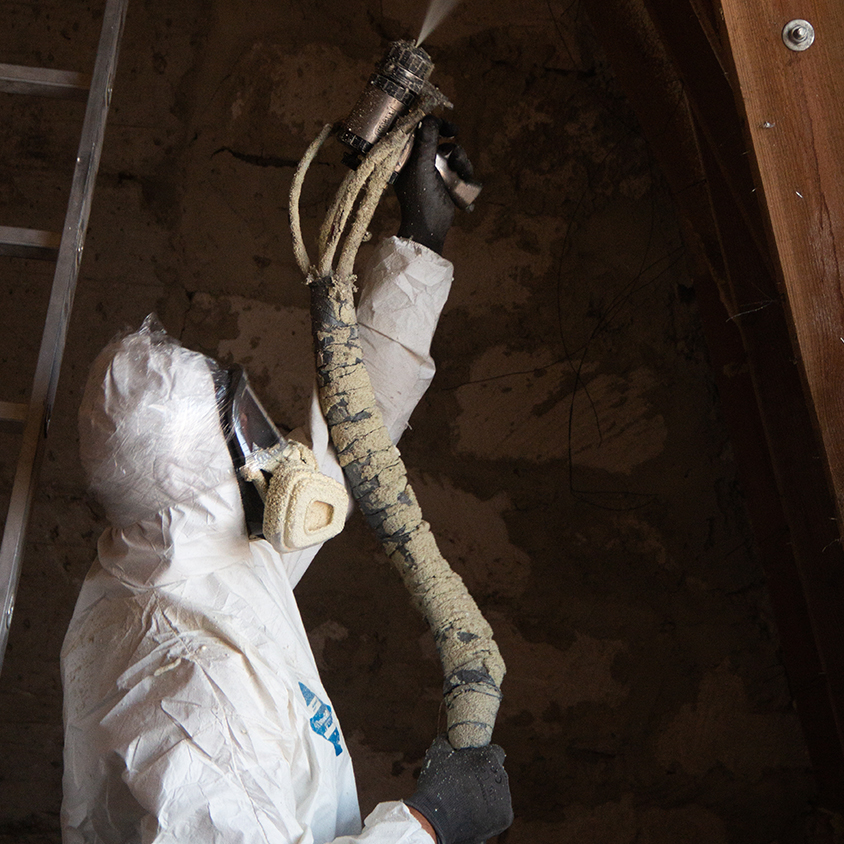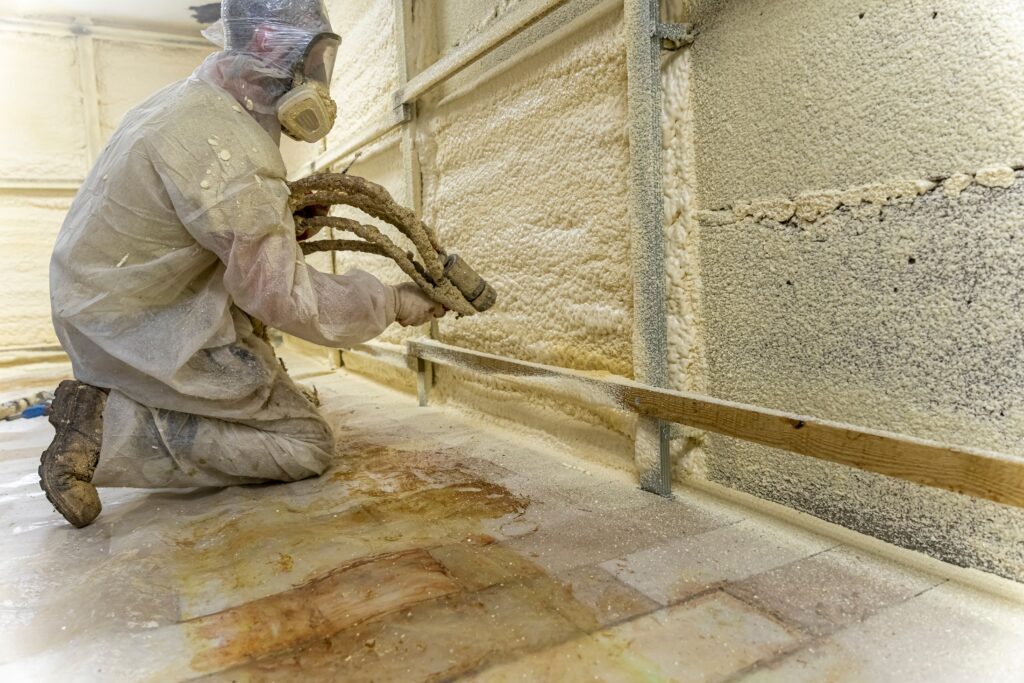
Spray foam insulation is combustible, meaning it can burn when exposed to sufficient heat or direct flame. It is not fireproof. When the appropriate product is installed according to manufacturer instructions and protected as required for the specific application, spray foam can be an effective insulation and air-sealing material for residential and commercial buildings.
Fire safety depends on more than the foam itself. The product formulation, installation location, whether the foam will remain exposed, manufacturer documentation, and applicable building requirements can affect whether a thermal barrier, ignition barrier, or other approved protective system is needed.
Planning a spray foam project in Dallas-Fort Worth? Contact RM Insulation at (214) 629-2669 to discuss an insulation approach suited to your building and installation area.
Is Spray Foam Insulation Flammable?
Yes. Both open-cell and closed-cell spray foam are foam-plastic insulation products that can ignite and contribute fuel to a fire under certain conditions. Neither should be considered noncombustible or fireproof.
When installed and protected for the specific application, spray foam can provide effective insulation and air sealing as part of a building assembly.
Here is what these fire-safety terms mean:
- Combustible: A material that can burn under fire conditions.
- Fire-resistant: A general term that may describe a material or assembly designed or tested to resist the effects of fire under specified conditions. It should not be assumed from the presence of spray foam alone.
- Fire-retardant: A description often used for additives or coatings intended to slow ignition or flame spread; it does not make spray foam noncombustible.
- Fireproof: Not an accurate description of spray foam insulation.
Understanding Spray Foam Fire Ratings
The phrase “spray foam fire rating” can refer to several types of fire-related testing or approvals. It does not automatically mean that spray foam can remain exposed in every application.
Depending on the product and installation, fire-related information may address:
- Flame-spread and smoke-developed test results for the foam product
- A tested wall, ceiling, roof, attic, or crawl-space assembly
- A thermal-barrier or ignition-barrier requirement
- An approved protective coating used with a specific spray foam product
- Installation limits, such as allowable thickness, location, and required covering materials
Always review the manufacturer’s technical documentation, installation instructions, and project-specific requirements. A foam product or coating approved for one assembly may not be appropriate for another.
What Happens When Spray Foam Is Exposed to Fire?
When exposed to sufficient heat or direct flame, spray foam may ignite or degrade and can produce smoke and combustion byproducts. Its response can vary based on the specific product, foam thickness, density, ventilation, fire conditions, and whether it is protected by an approved covering.
For example, spray foam behind gypsum wallboard in a finished room is part of a different protective assembly than spray foam installed along an attic roofline. The fire performance of the complete wall, ceiling, roof, attic, or crawl-space assembly—not the foam in isolation—matters most.
Thermal Barriers vs. Ignition Barriers
Thermal barriers and ignition barriers both address foam-plastic fire safety, but they apply in different settings and serve different functions.
Thermal Barriers
Thermal barriers separate foam-plastic insulation from the building interior, including finished living areas, offices, and other occupied spaces. Their purpose is to delay the foam’s exposure to high temperatures during a fire.
In many applications, 1/2-inch gypsum wallboard is the commonly recognized prescriptive thermal barrier. Other approved equivalent barriers or tested assemblies may be permitted when they meet applicable requirements.
Ignition Barriers
Ignition barriers serve a different, more limited purpose than thermal barriers. They are commonly associated with certain attics and crawl spaces entered only for service or utility access, rather than spaces used for living or storage.
An ignition barrier is not a substitute for a thermal barrier in an occupied interior space. Requirements can change when an attic or crawl space is finished, used for storage, or accessed beyond limited service needs. Some foam products may also have product-specific tested assemblies or exceptions, which should be verified through the manufacturer’s documentation and applicable requirements.
Open-Cell and Closed-Cell Foam Safety
Open-cell and closed-cell spray foam have different physical properties, but both require attention to fire-safety requirements.
- Open-cell spray foam is lower density and expands significantly during installation. It is often used in interior wall cavities, ceilings, and attic rooflines.
- Closed-cell spray foam is denser and typically provides a higher R-value per inch. It may be used where cavity depth is limited or where a denser insulation material is appropriate.
Fire-protection requirements are determined by the specific product, installation location, exposure conditions, and approved assembly, not simply by whether the foam is open-cell or closed-cell.
How to Make Spray Foam Insulation Safer
A safe spray foam installation starts with planning. Foam products, protective coatings, and barrier systems are not automatically interchangeable, so the selected system should match the installation location and approved product documentation.
To help reduce fire-related risks:
- Choose a spray foam product suited to the specific wall, ceiling, attic, crawl-space, roofline, garage, or commercial application.
- Follow manufacturer instructions for application, thickness, curing, ventilation, and required protection.
- Confirm the required protection before leaving spray foam exposed in an attic, crawl space, wall, ceiling, or other installation area.
- Use only protective materials, coatings, and assemblies approved for the specific spray foam product and application.
- Maintain appropriate clearances around heat-producing equipment, recessed lights, flues, chimneys, vents, and other heat sources according to applicable requirements and manufacturer instructions.
- Coordinate insulation work with electrical, HVAC, plumbing, framing, and fire-protection components.
- Request and review product documentation for exposed-foam applications, attic installations, crawl-space installations, or projects that use protective coatings.
- Use trained insulation professionals rather than treating large-scale spray foam installation as a DIY project.
How RM Insulation Can Help
Spray foam fire safety starts with selecting a product and installation method that fit the specific space. RM Insulation can help homeowners, builders, remodelers, and commercial property owners assess whether spray foam is appropriate for an attic, crawl space, wall cavity, roofline, garage, or interior area.
RM Insulation can help account for:
- The type of spray foam appropriate for the assembly
- Whether the foam will be covered or remain exposed
- Thermal-barrier, ignition-barrier, or approved-coating considerations
- Clearance needs around heat-producing equipment and building components
- Coordination with framing, electrical, HVAC, plumbing, and other trades
- Manufacturer instructions and project-specific installation details
Contact RM Insulation at (214) 629-2669 to request a quote or discuss a professionally planned spray foam insulation project in Dallas-Fort Worth.